


New Year/5 meditations & Somatic Practice/5 Bodies (Koshas)

Happy New Year! I hope wherever you are that you are well. In Zen Buddhism there is a word, “Shoshin”, it means “beginner’s mind.” It is cultivating an attitude of freshness, curiosity, and openness without any preconceptions. It allows us to clear away the debris, the thoughts, behaviors, or beliefs that lead us to anxiety, stuck-ness, or lethargy. We can do this anytime, but the new year creates a collective time to begin again. I hope we begin gently. We are still in the dark quiet of winter. All of nature is resting, it tells us that we need to rest too. How can we be mindful of the rhythm here?
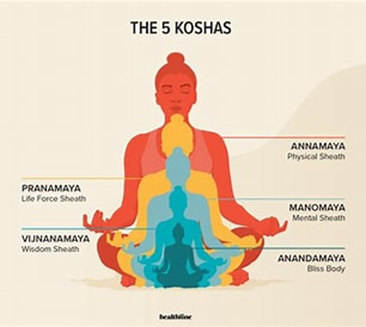
We are still in the resting of winter but maybe within that a little space has been created for something new. In what I hope will be a gentle beginning again, I invite you into the 5 layers of our being, the 5 Koshas. But let’s go slow, one at a time. Below is an explanation of the koshas as a framework for the 5 meditations. Practice, or embodied knowing, is much more important than all the information so if you may wish to just go to the end of each section and do the meditations.
One way to begin again is through the yogic Koshas. Koshas are subtle layers of our being sometimes described as veils or sheaths. You can think of wooden nesting dolls, each time you open one there is a smaller one inside until you get down to the smallest doll in the center. Even though we aren’t parts but whole beings, understanding ourselves in smaller more tangible ways can help us to create change in small doses.

Annamaya Kosha (Physical)
Annamaya Kosha or the food body is the most tangible layer. It is the outermost sheath sustained by nourishment. Outermost does not mean the least spiritual but rather that it is an entry point into consciousness, awareness, and awakening. We aren’t trying to transcend the body but rather become more grounded in it, to feel at home in it. The body is the material, biological layer that includes muscles, organs, skin, fluids, brain waves, nervous system, physiological processes, chemicals, cells, systems and so on. It includes neuroplasticity, the brain’s ability to change, grow, and heal. It is the brain/body connection. When the body is dysregulated, our thinking is dysregulated. Our awareness is shaped by signals in the body. Many new years resolutions have to do with this layer of self but unfortunately these often come from a place of comparison, a sense of not being good enough and judgment. If we can shift our thinking to nourishment instead of scarcity, we can help this layer without harming other parts of our self. Sleeping well, drinking enough water, moving, and eating foods that sustain us is essential to all parts of wellbeing. We can’t ignore the body even if our goals are psychological or spiritual. Having a grounded body is an essential base. If there is a major disruption in this layer of self, it is best to start here and get the support we need.
Pranamaya Kosha (Energy)
Sometimes a picture just says it best. Take a moment to ground your body, take a couple of deeper breaths. When you’re ready look at each of these pictures. Slow down to notice how each one individually affects your body. What do you feel when you look at the man in the office? What do you feel when you look at the lake?


“Prana” in Sanskrit (the language of the yoga sutras) means breath but it also means life force energy or vital energy. When we are in a state like the man in the first picture, when too much of our awareness is pulled from our center, we can feel overwhelmed, chronically distracted, exhausted, anxious and depressed. Presence allows us to pull all our vital energies inward so that we can feel more like a still lake. In meditation a still lake is often used as a metaphor for the stilling or slowing of the mind that often leads to a sense of inner calm or peace. The internal landscape becomes more spacious.
Prana is seated in the heart space. The heart space rests on the horizontal plane of the respiratory diaphragm. We can ground and support the heart space and our energies through the breath. There are many types of breathing practices. I’d invite you to not get caught up in finding the right one but only to explore what feels helpful to you.

Manomaya Kosha (Mental)
Manomaya Kosha is the mind or mental sheath. Mind states can be contagious. We’ve all had experiences of being hooked by a negative thought or mental state that when stuck in it continuously generates an anxious or lethargic mind/body. Unhooking from negative thoughts and orienting more to presence is essential for peace when stuck in the contagion of dis-ease. Meditation and Somatic practices can help us first to slow down enough to recognize that we are not our negative thoughts and that we can orient to presence moment experiences that just fell better, more life affirming. Meditation, glimmer practice (orienting to things/people/places that help us feel a sense of wellbeing), yogic philosophy (ethics & observances) & affirmations are some ways of working with the mind.

Vijnanamaya Kosha (Wisdom)
Vijnanamaya Kosha is the wisdom sheath. When we can still or quiet the fluctuations of the mind we can observe our deeper wisdom and discernment. We can remember the wisdom we have cultivated over the years. It is the helpful readings, teachings, and life wisdom that is truly supportive not only to ourselves but also those around us. Discernment is different from judgement because it doesn’t include comparison or worthiness. It is choice and knowing based on wisdom instead of fear, anger or reactivity. I believe wisdom is also our gut or intuitive knowing. Confusion and indecisiveness can be an indication that we are not present and living too much in just our minds and not in our wisdom or intuition.

Anandamaya Kosha
Anandamaya Kosha is the bliss or joy body. It is the most innermost layer closest to that of pure awareness. When we can let go of our expectations, conditions, scarcity, comparison, worry and regret and be in the moment we may encounter a joy that isn’t based on getting something but rather an internal state of goodness. Most of us have experienced this state, if only a glimpse, but enjoyable when we encounter it. If you’ve ever had that state of feeling connected and blissful at the end of yoga class, that is Anandamaya kosha. Sensing the interconnectedness of all beings, that is Ananda. Experiences of wonder and awe signal the presence of Ananda. Or moments of gratitude and appreciation just because, that is Ananda. Although we can’t force this state, it seems to arrive spontaneously, we can cultivate the environment for it to show up through: loving kindness meditation, glimmer and savouring practices, gratitude practices, acts of service, singing, dancing, creating and lovemaking. Working with the previous four bodies will help with providing the awareness and the ability to feel and stay with Ananda when it arises.

Happy meditating! I'd love to hear how it goes.
If you are interested in working with me I offer a free 15 minute consultation over the phone to see if it feels like a good fit. You can either email me to set something up or Book Online here.
Love, Kerri


Comments